


Fuck. I feel like I’ve wasted my twenties. I’ve squandered opportunity after opportunity. I’ve disappointed peers who admired me and mentors who supported me. I have no career path. I’m hopelessly lost. Time is running out, and the walls are closing in.
How did it all go so wrong?
When I started music school, I imagined I’d already made it. I was excited to join the ranks of Laufey and John Mayer and other notable Berklee alumni, and felt that it would be smooth sailing from there on out. I could not have been more wrong. While my peers worked hard — writing songs, booking shows, building relationships, I fell back into old habits — slacking off, neglecting assignments, doing the bare minimum.
It’s fitting that my first release was called Neverland. It was about leaving someone you love to chase your dreams. When I showed my songwriting professor the demo, he said my lyrics had the wide-eyed innocence of a child.

“’You’re saying my music is childish?” I asked.
“Not childish- “ he clarified. “Childlike.”
Here’s the difference:
In art, ‘childlike’ is a virtue. A child is raw, direct, and honest. Rick Rubin says that great artists manage to preserve their childlike spontaneity, curiosity and wonder. Picasso said it took him “four years to paint like Raphael, but a lifetime to paint like a child.”
‘Childish’, however, is a vice: irresponsible, avoidant and impatient. Impulsive, entitled, and emotionally volatile. These are the traits responsible for my current desperate situation: I’m broke and unemployed, yet again, and no closer to achieving my dreams.
My affliction is known by many names: Peter Pan Syndrome. Type 4 Enneagram. Puer Aeternus. Manchild.

Let me paint you a picture.
Carl Jung describes the puer aeternus, the ‘eternal boy’, as one stranded in adolescence. The puer carries a ‘sack of childish illusions,’ living in a ‘passive fantasy’. He believes he is special/exceptional, though he has no product to show for it. He is easily frustrated. He idealizes freedom and avoids commitment. As a result, he lives a sort of ‘provisional life,’ one he feels has ‘not yet truly begun’.
Sound like anyone you know?

The eternal child is particularly incapable of sacrifice. He cannot bear the thought of losing his potential. Unable to commit to a path, he stands frozen as the fruit of Sylvia Plath’s metaphorical fig tree fall and rot around him.1
He is like a stem cell with anxiety — all potential and scared to lose it. But the stem cell that never differentiates remains, at best, useless — or becomes, at worst, cancer.
How does one devolve into such man-child-hood? For me, it was a mix of dispositional and situational factors. A lifetime of coasting through school. Technology that made instant gratification disgustingly easy. And a misguided belief in ‘exploration’ over commitment.
When I was 18, I read The Defining Decade, which suggested maximizing your twenties by following your interests and exploring various career paths. The message: life cannot be prescribed. It must be discovered, moment by moment.2
But what I (mis)heard was: “You can fuck around in your 20s without consequence.”
So I switched from path to path, skimming the surface, never diving deep. I half-assed jobs and bailed when times got tough. Hell, I even threw away a promising medical career because it didn’t feel special enough3. All in the name of ‘exploration’.
And don’t get me wrong — I’m glad to have experimented, and I know it was a privilege. But I wish I’d committed to the work and taken it seriously. I wish I’d built lasting relationships instead of burning bridges. I wish I’d tried harder when I had the chance.

Alright, pull it together man. Enough ruminating. Where do we go from here?
According to Jung, the solution is simple: Lock The Fuck In.
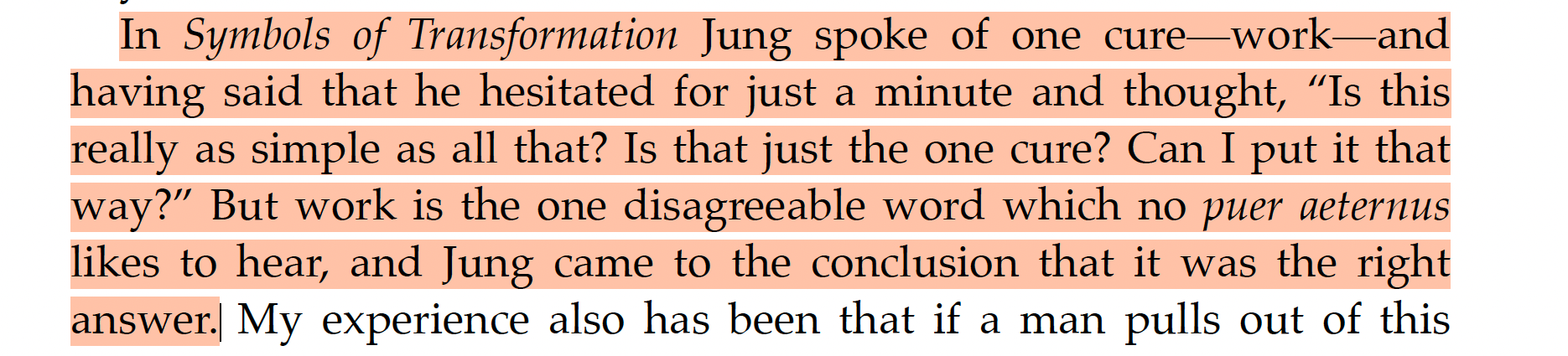
Wait. That’s it? Gee, what a revelation!!
Not exactly.
Harvard psychiatrist Dr. K (@HealthyGamerGG) clarifies the type of ‘work’ Jung prescribes.
It doesn’t mean working when you feel like it, he says. Anyone can do that. Nor is it ‘working’ in order to avoid more important work4. What the puer aeternus needs — what he’s unwilling to accept — is to work when he doesn’t feel like working.
The boring work. The soul crushing grind. The bills. The dishes. The laundry.
Or in Ryan Holiday’s words: sweeping the floor, every minute of the day, then sweeping again.
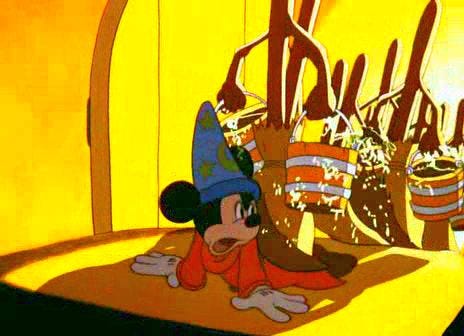
That’s what it means to grow up. And deep down, I’ve known this. But I’ve resisted the call for so long, partly because I equate ‘maturity’ with the loss of those childlike traits I hold so dear.
But maturity doesn’t mean killing the inner Child, Dr. K asserts. Quite the opposite —only by managing your impulses, sacrificing your ‘potential’, and embracing responsibility, can you create space for the Child to thrive.

Dr. K gives me hope that the door is still open, just a crack. That if I give it my all, right now — if I give up my childish fantasies of leisure, of preserving ‘potential’, of avoiding work — I might still make it to Neverland.
I just pray to God I’m not too late.

“I saw my life branching out before me like the green fig tree in the story. From the tip of every branch, like a fat purple fig, a wonderful future beckoned and winked. One fig was a husband and a happy home and children, and another fig was a famous poet and another fig was a brilliant professor, and another fig was Ee Gee, the amazing editor, and another fig was Europe and Africa and South America, and another fig was Constantin and Socrates and Attila and a pack of other lovers with queer names and offbeat professions, and another fig was an Olympic lady crew champion, and beyond and above these figs were many more figs I couldn’t quite make out. I saw myself sitting in the crotch of this fig tree, starving to death, just because I couldn’t make up my mind which of the figs I would choose. I wanted each and every one of them, but choosing one meant losing all the rest, and, as I sat there, unable to decide, the figs began to wrinkle and go black, and, one by one, they plopped to the ground at my feet.”
―Sylvia Plath, The Bell Jar
Henrik Karlsson also suggests allowing life to unfold by paying attention to what makes you feel alive.
527 MCAT btw
(e.g. writing essays instead of applying to jobs.)
Great stem cell analogy. Everlasting potential is self-destructive.
try not to mention the fig tree metaphor impossible challenge