

the act of friendship presupposes an illogical leap of faith.
tackling my social problems (pt.1?)

I live in New York City, one of the most social cities in the world. Some nights, when I go out, it’s easy for me to make friends — I’m flowing, I’m warm and active and charismatic, and I feel others are drawn to me. Other nights, I’m rigid and cold and cannot get myself to connect to anyone. I’m very inconsistent, very hit or miss. I never understood why.
I’m told I come off as standoffish. I’ve also been told I’m extremely friendly. Truth is, I’m both — I like people; I like making friends, though I have a lot of social anxiety which manifests as a coldness, a chip on my shoulder. Yeah, it’s a defense mechanism. I’m subconsciously protecting myself from the possibility of rejection. It’s embarrassing, painful, to reach toward someone and get shut down.
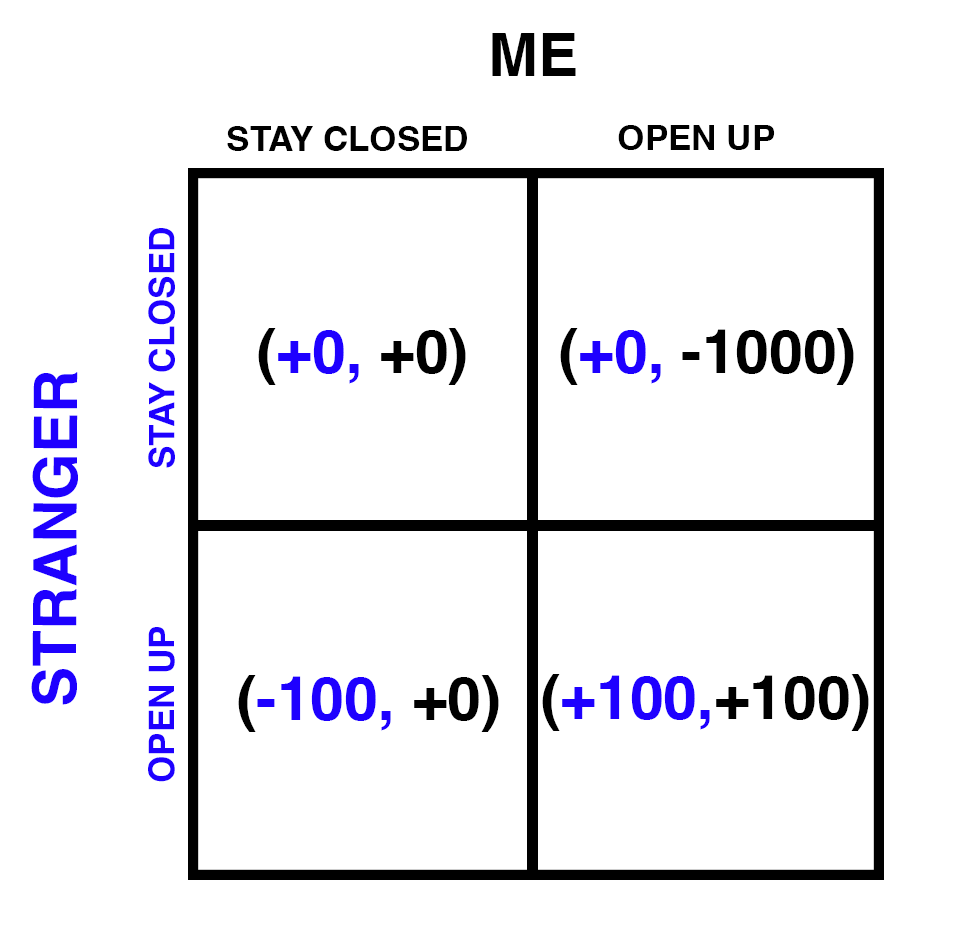
I see it as a Prisoner’s Dilemma. Between me and this stranger, the best possible outcome is when we both open up and allow for connection. A new friendship is a blessing and even a brief, positive interaction is nourishing. But to get there, I must risk brutal, painful, shameful rejection. Which I just can’t do. So I stay closed. And so does the stranger.
My friend Julie told me she overcame her social anxiety by realizing she could just talk to anyone. So I forced myself to talk to people: I’d share a few words with the cashier, the man playing guitar, the nice old lady on the subway, and I felt empowered by these interactions — for the rest of the day, socializing became easier. But the next day, the fear would return in full force, and most days I could not overcome it.
Still, I want to make more friends; I want to relate better to others. So I’ve been reading and writing a lot about friendship, trying to identify my flawed beliefs. Turns out, I have many.

Sasha Chapin is someone who easily makes friends wherever he goes, and he’s married to Cate Hall, which I consider an unshakable vote of confidence.
He suggests these two assumptions:
Everyone is my new friend who I haven’t met yet
Everyone will immediately want to stop talking to me
Basically, two boundaries: an openness to connection, balanced with an acceptance of possible rejection.1
But it’s that first assumption — everyone is my friend — that feels so unbelievable to me. How can you know for sure? What evidence do you have? Isn’t a stranger just as likely to brush you off, laugh you away? What proof is there that if I give warmth into the world, I might receive it back in equal or greater measure?
Or is there no way of knowing? After all, even old friends do not guarantee continued reciprocity. Instead, we develop trust over time — evidence that when you give, you get. But for new connections, since there’s no evidence, what’s required must be an unproven, illogical leap of faith.

So I’ve been trying it. It feels stupid to admit, but over the past week, I’ve been telling myself, this person could be my friend; that person could be my friend, about random strangers everywhere. I’ve made friends on the street, at the basketball courts, and at the Chinese restaurant. I went to my first Substack reading the other day, held this mindset, and met more people than ever. Real connections, too. Hi guys.
Changing any core belief is painful, especially when it exposes your shortcomings. I feel like I’m bleeding all over this page. But maybe I’ve been wrong this whole time, and it actually is that simple, and the world really could become a warm, loving place full of friends I have yet to make, and all I need to do is close my eyes, take that first step, and plunge into the void.

april expands on that first point:
I want to get to know you, see the way you see the world. All my cards are on the table, and I’m inviting you to reveal yours, indulge in play. I enjoy the conversation, I enjoy making people feel understood and heard and cared for. Because to me, people very rarely feel like strangers. The moment we meet, I already assume we are friends.
Based and warmpilled 🔥 guy in the corner of a party meme “they don’t know they’re all already my friends” this is the WAY
kierkegaard mentioned!! what the fuck is certainty in the face of the absurd? in all seriousness i find it interesting and beautiful that the leap of faith is used in this context of seeking community bc kierkegaard’s notion of “the leap” in the context of religious faith defines the experience as very isolating. the “knight of faith” must pursue god alone. faith à la kierkegaard is a solitary journey, requiring a single individual to separate themself from the group in order to enter a relationship with god. however, in a more secular context of friendship, a single individual is already alone and the opposite is true: it requires an immense leap of faith to reach out into community. in a highly individualistic society where we have made gods of ourselves it takes an unthinkable and frightening movement to return to each other and though it is harrowing it is incredibly rewarding. really emotional over how this piece analogizes god with human connection ❤️ all this to say that human connection is a divine act and maybe it will save us a little bit