

why I'm leaving the Red Pill.
my time in the manosphere

I discovered the Red Pill at perhaps my lowest point, in the summer of 2023.
I was in love with a girl who didn’t love me back. I hadn’t had sex in nearly two years. My face had been marred by a bacterial infection that destroyed my right eyelid; it took a year for the subsequent surgical swelling to subside. I was ugly, out of shape, and I reeked of desperation.
So when she (inevitably) ghosted me, I decided enough was enough. I would learn to attract women — no matter the cost.
Until then, I had been a Good Feminist Boy. I grew up in a liberal bubble — a college town in the Midwest where ‘female empowerment’ was the air we breathed. My role models were women: single mom, older sister, and figure skating coaches. Even in college, I’d never questioned the narrative that men oppressed by manspreading and mansplaining. I’d only ever voted blue.
But in my hopeless state, I felt that feminist dating advice (be sensitive! be vulnerable!) had failed me. So I sought the forbidden fruit. Red Pill ideology validated my suspicion that my core beliefs were fundamentally flawed. It offered an alternative worldview.
The truth, it promised, would convert me from Chud to Chang.

Let’s take a closer look at the ‘truths’ in question:
1. Men and women differ psychologically.
In 2017, a senior engineer at Google released an internal memo suggesting that gender representation in software engineering and leadership differed primarily due to inherent psychological differences rather than overt discrimination.
James Damore’s ideas challenged the popular egalitarianism of my youth — the concept that “men and women are psychologically identical apart from social conditioning.”
But Damore cited robust scientific research: women tend to have higher verbal IQ; men, higher spatial. Women are more neurotic, men more disagreeable. Women prefer working with ‘people’; men prefer ‘things’. These, in addition to consistent population-wide differences in brain structure and hormone environment, strongly suggest that men and women fundamentally process the world differently.
Did this mean that women were less capable than men? Absolutely not. Damore was careful to specify: individuals exhibit a wide range of preferences, interests, and ability. Any particular woman could outperform any man in any given field. But individual variance does not negate population-wide trends; the sexes are asymmetric.
Dmitry expands on how differences in personality are synonymous with differences in values, which have downstream implications on morality and political orientation: Disagreeable men are more likely to value competition, power, and truth over social compliance and become drawn to ideologies that celebrate these masculine values rather than condemn them. (Hint, hint.)
Unfortunately, Damore’s memo was ahead of his time. Intended only for his peers, it was leaked to Gizmodo, reprinted without sources or citations, and framed as an “Anti-Diversity Screed.” In response to the frenzied social media backlash, Google made the prudent business decision to renounce the supposedly ‘harmful stereotypes’ contained within, and James Damore was fired.

2. Women like being sexualized.
At the time, I was a freshman in college.
It was the heyday of ‘woke’. Progressive liberalism, concerned with social justice and political correctness, cultivated a culture of strictness, censorship, and cancellation — of which James Damore was an early casualty. Campus protestors rallied over trans-inclusion, reproductive rights, and the event that shaped my generation’s sexual politics: the #MeToo movement.
Undergrads attended mandatory sexual conduct seminars, where we learned that drunk sex was rape, women shouldn’t be sexualized, and consent had to be verbally explicit: “Can I touch you? Can I kiss you? Do you want to have sex?” Though well-intentioned, institutions failed to distinguish between genuinely predatory behavior and normal masculine desire. The goal seemed not to be correction, but castration.
Additionally, absence of important legal rights like due process in Title IX cases contributed to campus-wide false-rape-phobia. Men had no protection against false accusations or social media mobs. We had our futures to consider. When it came to sex — better safe than sorry.
This societal fear compounded with my instinctual fear of rejection and personal fear of intimacy (divorced parents, we can unpack that later). The Red Pill, in contrast, was a refreshing escape. Consent doesn’t have to be verbal — it can be expressed physically. Women do want to be sexualized — by men they find attractive.
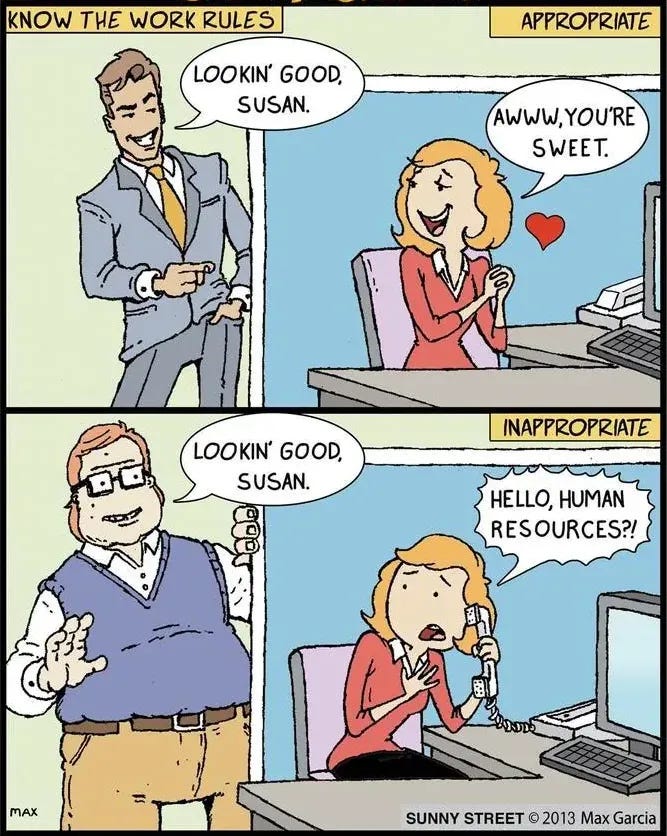
It’s alright to want to have sex with a woman. It’s alright to express it openly. In fact, she probably already knows.
3. You can learn to be attractive.
Fast forward to that desperate, sexless summer post-eye-infection.
What the hell did women want? When I was younger I thought it was all about looks. Then I heard it was personality: girls like guys that are sensitive and nice. But actually, nice guys finish last, so just be confident. No wait, don’t try too hard; just be yourself.
I spent weeks digging through Pick Up Artist forums, looking for answers. But what I found only complicated the picture: Women like Alphas, and Status, and MoneyMusclesGame; they’re Hypergamous and respond to Frame and Demonstrated Value and — was this shit for real?
I gave it a try. I got back in shape, studied Game tactics, then put the principles to practice.
And it worked. I attained the sexual validation I craved.

I’ve since realized that Game is just a set of social skills for expressing and perceiving sexual attraction in a way that is sensible, exciting, rewarding, and socially aware, leading to mutually beneficial sexual interactions. Basically, Flirting for Autists.
I also came to my own conclusions about attraction: looks open the door, but personality takes you through it. Women are attracted to strength — physical, mental, and emotional — which manifests sometimes as status/dominance, sometimes as emotional awareness/kindness.
Confidence does not apparate fully formed in the world, but is built slowly through skill development and progressive achievement. Confidence is the psychological manifestation of power.
But once I had it — then, I could ‘just be myself’.
So I became a closeted apostle of Red Pill theory.
When my buddy was brutally dumped by his fiancée of many years, I gave him my copy of The Rational Male (a.k.a. the Red Pill Bible) — a tome outlining the mechanics of female attraction using the analogy of a sexual marketplace. It helped him understand why, though he’d been the ‘perfect partner’, he’d lost her.
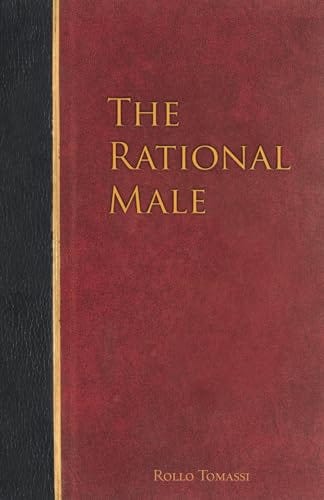
The book is admittedly a blend of truth and pseudoscience, more so a labor of love than serious scientific literature. But Rollo Tomassi’s theories stemmed from decades of experience, and — critically — they were effective.
My buddy went on a year-long promiscuous crusade. He broke a few hearts. Then, more confident and experienced, he entered a serious relationship with a better understanding of what he provides as a man. In retrospect, he tells me that Red Pill knowledge is dangerous and should not be disseminated. But he thanks me anyway —
With knowledge of evil, he says, he can teach his nephews to be good.
For years, I’ve kept these beliefs private, for obvious reasons.
Popular media tends to depict the Red Pill in one of two ways: as fringe extremists, à la Andrew Tate and the Incels1, or as grifters preying on foolish young men, so portrayed in Louis Theroux’s Netflix documentary. Neither captures the constellation of disparate communities, beliefs, and worldviews — some misogynist, others not — that comprise the Manosphere.2
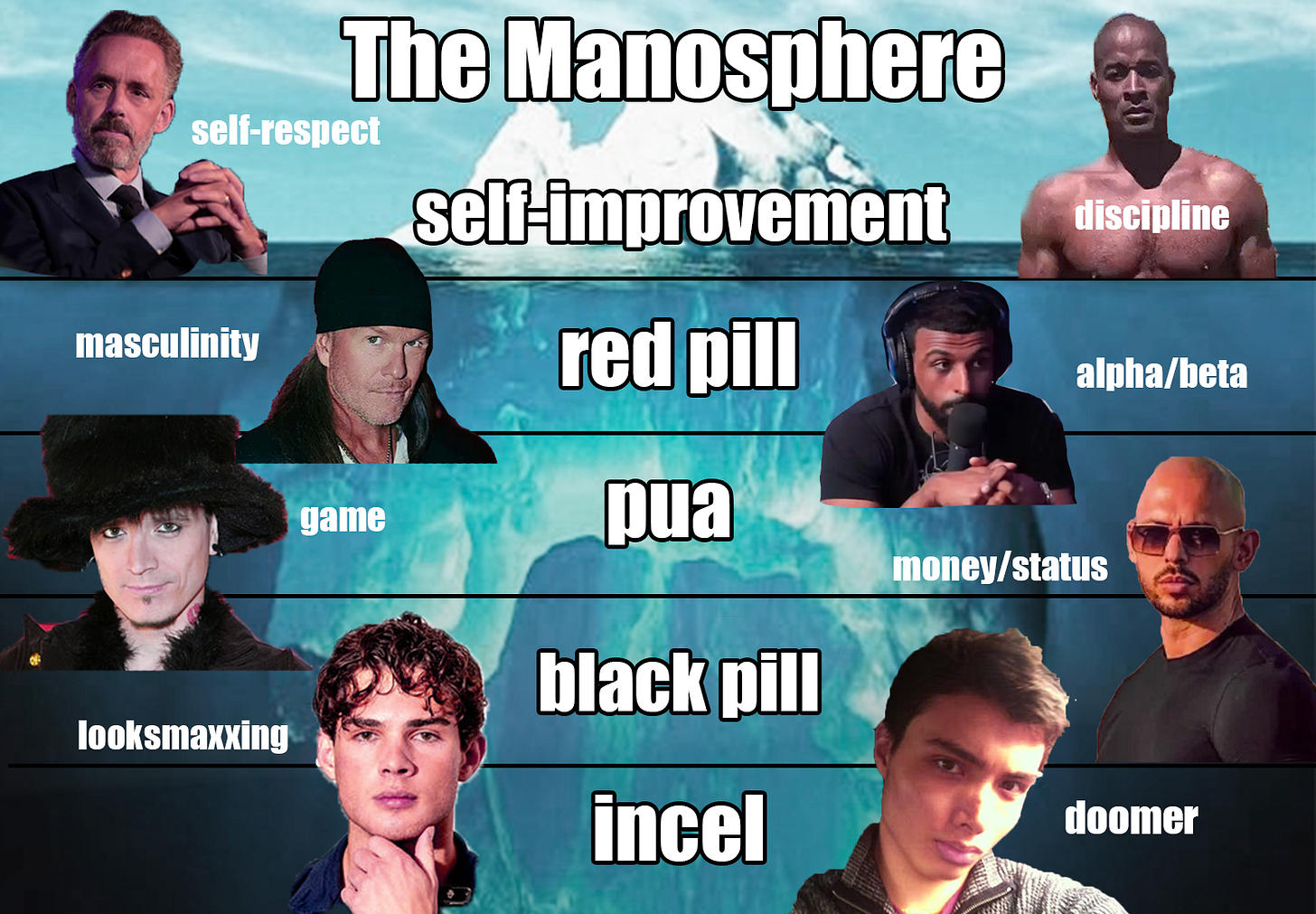
And neither explains why millions of normal men find its message so compelling.
The Red Pill targeted a generation of men disillusioned with overarching narratives about masculinity. It sympathized with their problems, validated their grievances. And it provided long-sought masculine community, united against a common enemy: Feminism.
Was there a core of truth? In the hundred plus years since women secured the vote, rapidly changing social contexts have rendered traditional masculine roles of ‘provider’ and ‘protector’ obsolete. Reverse-discriminatory practices, like the ones James Damore criticized, disadvantaged young men in work and education.
Most men I’ve talked to agree: the Manosphere has a point.
But here’s what the Red Pill gets wrong.
Although gender roles have biological foundations, their expression is not immutable. The context has shifted; the cat is out of the bag. Women are firmly entrenched in education and the work force; Zoomettes are out-earning their Zoomer peers. Traditional gender roles are dead, and Masculinity will have to adapt.
Further, it’s become clear that the highest values of the Red Pill movement are not actually truth and self-improvement, but controversy, attention, and self-victimization. Blame and ‘what-about-ism’ pervade the discourse. Amplified through social media echo chambers, the gender wars have become the Oppression Olympics.
And it’s impossible to ignore the hatred, harassment, and calls-to-violence rampant throughout the Manosphere.
Following the 2018 Toronto van killings, Jack Peterson (no relation to Jordan) defended the incel community from accusations of misogyny: they’re just misunderstood! Imagine his surprise when incels clarified, ‘No, we’re not. We hate women.’

I’ve got mixed feelings about this. In high school, I’d occasionally browsed incel forums with Schadenfreude — sure, my life sucked, but at least I wasn’t a total loser virgin.
But since my surgery and two years of sexlessness, I’ve had to wonder:
What if my eyelid were still swollen like a grape? What if it had never healed? What if I hadn’t had a privileged upbringing, extensive education, and deep-rooted athletic habits? What if I’d never received even a crumb of female affection?
Wouldn’t I still be down there too?

We live in a post-Red-Pill world.
The Red Pill has gone mainstream. Anti-egalitarianism is no longer a fringe position. Game, incels, male grievance — these topics have become common knowledge. Societally, the Red Pill has served its purpose.
For me as well, it’s run its course. The Red Pill taught me to question my unexamined beliefs and to distrust popular narratives. But it did not make me a better person or more productive member of society. Contrarianism is not truth, and ideology is a crutch. To further my intellectual and personal growth, I’ll have to move on.
James Damore, by the way, is doing well. He moved to Europe, found a stable job, and learned to avoid the internet. He left the controversy behind and found peace.
It may not be possible for men and women to see eye to eye. Still, there must be a way to reconcile amoral Red Pill truths with pro-social values in a way that neither disempowers women, nor dismisses men’s legitimate grievances. Synthesis, rather than reversal.
But until then — as long as men feel unheard, as long as masculinity is villainized and obvious truths are systemically denied — the Red Pill will continue to flourish.
And we will have to live with it.

sick band name btw
on that note, the best broad overview is laura bate’s ‘men who hate women’ which does a great job of covering the different factions and objectives of the manosphere, though from a moralistic feminist perspective.
I think the red pill can't be reconciled with society, it is a genuinely anti-social belief system. The smoking gun there is the fate of the pickup community: there used to be one, where guys supported each other in their quest to master seduction, but it all fell apart and left no legacy. This does not happen to pro-social projects.
As for guys that get drawn to rp, the counter is that they need to find what they value in life that is above the approval of women. Really the gist of Mark Manson's Models, that's a guy who got fed up with pick-up.
I think ur flexibility to change your mind will take u to reached safety, god bless you